

Today the question is no longer "should I use ChatGPT for content marketing?" but "how do I use it so that it really adds value instead of producing mediocre, interchangeable content?" The distinction is fundamental: there's a chasm between people who use AI to press a button and get generic text and those who build systematic workflows in which AI amplifies their human expertise.
This guide is about the second kind. I show you how to integrate
Sources: Brynjolfsson, Li, Raymond, NBER (2023); Noy and Zhang, Science (2023)
The right framework: AI as a collaborator, not a ghostwriter
Content written entirely by AI without human supervision has a fundamental problem: it's generic. ChatGPT knows everything superficially and nothing in depth. It has no first-hand experience, no genuine opinions, and doesn't know your specific sector the way you do. If you publish pure AI content, you're publishing the same thing anyone could publish with the same request.
The model that works is different:
AI without human expertise = generic, interchangeable content
Human expertise without AI = slow, not scalable
Human expertise + AI = quality content produced quickly
Advanced prompts for your blog: from research to publication
Producing a blog article with AI is divided into distinct phases. Each phase needs different prompts.
Phase 1: Keyword research and the article's angle
Before writing, you need to understand what your audience is looking for and how to stand out from the competition. ChatGPT can help with initial research, but it must be complemented by real SEO tools (Ahrefs, Semrush) for volumes.
"You're an SEO expert. For the main keyword '[keyword]', generate a cluster of 15 related keywords divided by intent: informational (guide, tutorial, what is), commercial (comparison, best, which to choose) and transactional (buy, prices, quote). Format: a table with keyword, intent and estimated difficulty (low/medium/high)."
"Analyse the top 5 Google results for '[keyword]'. Assume standard articles on this topic already exist. Suggest 5 original angles to stand out: unusual perspectives, surprising data, controversial but defensible positions, unusual formats. Each angle in 2 lines."
Phase 2: The article's structure
"Create a detailed outline for a 3,000-word article on '[topic]' aimed at [target audience — e.g. owners of small Italian businesses]. The article must: match the [informational/commercial] intent, include sections on [key topics] and take a practical approach with concrete examples. Format: H2s and H3s with a short description of each section (2–3 lines) and an indication of the type of content (list, table, callout, statistics)."
Phase 3: Writing the sections
Never ask ChatGPT to write the whole article in one go. Write section by section, providing specific context for each.
"Write the '[section name]' section for the article on '[topic]'. Context: [add your specific knowledge, first-hand experience and real data you want to include]. Tone: [professional but direct, first person, etc.]. Length: about [X] words. Include: [lists, callouts, bold on key concepts]. Do NOT use: generic phrases such as 'in today's digital world', 'it's essential', 'in the modern era'."
ChatGPT for social media: adapting content to each platform
Every social platform has its own language, format and best practices. ChatGPT excels at repurposing: taking long-form content (an article, a video, a podcast) and adapting it into formats optimised for LinkedIn, Instagram and X/Twitter.
"Here's an article: [paste the text or summary]. Create 5 distinct LinkedIn posts, each with a different angle: 1) the most surprising statistic, 2) the common mistake in the sector, 3) the main practical tip, 4) an open question to spark comments, 5) the strongest quote. Each post: max 1,300 characters, starting with a strong hook (first line), no empty hashtags, emoji used sparingly."
"Write 3 versions of an Instagram caption for this content: [description of the post/image]. Target: [describe the audience]. Goal: [grow followers / drive traffic to the link in bio / spark comments]. Each version in a different tone: professional, personal/narrative, direct/inspirational. Include a clear CTA and 5 relevant hashtags for the target market."
ChatGPT for email marketing: sequences and subject lines
Email is one of the formats where AI brings the most immediate value: it speeds up writing long sequences and helps you test subject line variants without having to come up with ideas from scratch.
"Write 10 subject line variants for this campaign: [describe the email's content and goal — open / click / purchase]. Target: [who receives the email]. Include variants with: a specific number, a direct question, a curiosity gap, urgency (real, not fake), personalisation with [Name]. Length: max 50 characters per variant. Format: a table with the subject line and the type of approach."
"Create a 5-email welcome sequence for [type of business]. The subscriber signed up via: [lead magnet]. The sequence's final goal: [booking a call / buying product X]. Email 1 (day 0): deliver the lead magnet + introduction. Email 2 (day 2): a credible personal story. Email 3 (day 4): the most valuable content. Email 4 (day 6): removing the main objection. Email 5 (day 8): the main CTA. Each email: subject line + preview text + body (200–350 words) + CTA."
ChatGPT for SEO: advanced optimisation
Beyond writing, ChatGPT is useful for several specific SEO tasks.
"Write 5 meta description variants for this page: [URL or content description]. Main keyword: [keyword]. Each variant: exactly 155–158 characters, including the keyword, ending with a complete sentence (no ellipsis) and including a concrete promise or CTA. Format: a table with the variant and its character count."
"For the article on '[topic]', generate 8 FAQ questions optimised for FAQPage schema and voice search. The questions must cover practical aspects (cost, time, how to), common objections and comparison questions ('is X or Y better?'), plus at least one question specific to 2026. Each answer: 60–120 words, direct, with secondary keywords distributed naturally."
"Here's an article on '[topic A]' and a list of existing articles on the blog: [list of titles/slugs]. Identify the 3–5 most relevant internal link opportunities: for each link, suggest the ideal anchor text (2–4 descriptive words with a keyword) and where in the article to place it (quote the paragraph or the H2 section). Prioritise links with strong topical relevance."
ChatGPT's limits in content marketing: what it can't do
Using AI effectively also means knowing its limits so you don't rely on it blindly where it doesn't help.
A practical workflow: one article in 2 hours instead of 6
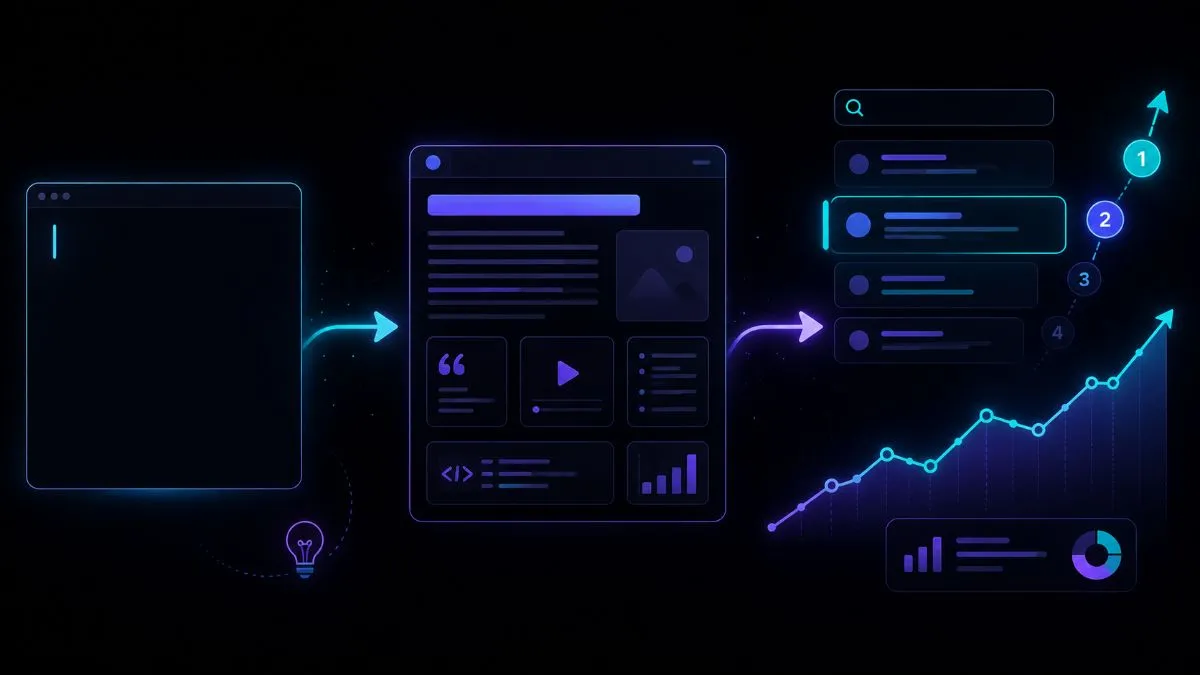
Here's the real workflow I use to produce blog articles with AI:
Keyword research with Ahrefs. Analysis of the top 10 results. Identifying the missing angles. ChatGPT: generates keyword clusters and suggests alternative angles.
ChatGPT: generates a detailed outline. Me: I edit it, remove useless sections and add sections from my own expertise. The result is a hybrid outline.
ChatGPT writes each section with specific prompts. Me: I add real data, personal examples, genuine opinions and case studies. Every section is supervised, not published as is.
A full review: I add my personal voice, remove typical AI phrases ("in the digital world", "it's essential to remember"), add internal/external links and optimise the H2s/H3s for SEO.
AI trends in content marketing
The AI landscape is evolving fast. The most relevant trends of 2026:
Integrated multimodal models: the latest models work natively with text, images and audio. This opens up workflows where AI not only writes the article but suggests images, generates optimised alt text and creates scripts for related video content.
AI for real-time optimisation: Tools such as Clearscope and Surfer SEO integrate AI that analyses your draft in real time and suggests adjustments to improve its SEO score against the current SERP — not a general estimate but a direct comparison with the competitors already ranking.
Content personalisation at scale: AI that adapts content to the visitor's profile: a version of the article for beginners vs experts, for different sectors, for different stages of the customer journey. Already possible today with tools such as Adobe Target + AI, and becoming accessible fast.
Voice search and AI Overviews: Content optimised for direct answers (FAQs, step-by-step guides, definitions) gets cited in Google's AI Overviews. ChatGPT can help you structure content in a format Google's AI can "cite".
AI tools that complement ChatGPT: the ecosystem
ChatGPT is the starting point but not the only tool. In 2026 there's an ecosystem of specialised AI tools for every phase of content marketing, each with its own area of excellence.
Claude excels at writing very long texts (pillar articles, white papers, complete email sequences) while keeping the tone and style consistent throughout. Its large context window lets you share an entire existing document and ask it to expand it while keeping the original style — something ChatGPT handles less well with very long texts.
For finding statistics, up-to-date data and verifiable facts, Perplexity beats ChatGPT because it cites its sources and accesses the web in real time. Use it to find up-to-date industry statistics to include in your articles — then cite the original source, not Perplexity itself.
These tools analyse the current SERP for your keyword and tell you exactly which terms, topics and structure to use to compete. They integrate AI to suggest optimisations in real time as you write. ChatGPT's output often goes from 60 to 80+ on Surfer after a manual review guided by their suggestions.
Article cover images, illustrative graphics, images for social media: generating them with AI reduces the cost of visual production to almost zero. Midjourney produces high, editorial-quality images; DALL-E is built into ChatGPT Plus for a smoother workflow. Always specify the style, proportions and brand colour palette in your prompt.
Building an AI-assisted content marketing system: from a single email to the editorial plan
The real competitive advantage isn't using ChatGPT for the occasional article: it's building a
A monthly editorial plan that used to take 3–4 working days (keyword research, planning, briefing copywriters, review) can be handled in 4–6 hours with an AI-assisted system. Here's how:
Monthly planning (1 hour with AI): Give ChatGPT your editorial plan for the last quarter, your list of target keywords and the month's goals. Ask it to suggest 8–12 topics for the month with an angle, a recommended format and a main keyword. You choose and edit: 15 minutes instead of 2 hours of brainstorming on your own.
Weekly production (2–3 hours per article instead of 5–6): With the 4-step workflow described in the previous section (research, outline, section-by-section draft, review), a 2,500-word article takes 2–3 hours of actual work. The review and personalisation phase remains entirely human: that's where you add the value AI can't replicate.
Multichannel distribution (30 minutes per article): Once the article is published, prompt ChatGPT to generate 5 LinkedIn post variants, 3 Instagram captions, 2 X/Twitter threads, and the subject line and body for the week's newsletter. In 30 minutes you have material for the whole week's social plan, consistent with the main content.
The result is a volume of content that used to be within reach only of those with a dedicated team, now achievable by a single professional or a small agency.
Mistakes that make AI content marketing fail: how to avoid them
Despite the obvious advantages, many businesses start using AI for content and get disappointing results. The mistakes almost always follow the same patterns.
How to build a content library with AI: assets that work for years
The most effective long-term content marketing strategy isn't producing lots of ephemeral content but building a
With AI, building this library is faster than ever. The process starts with mapping your target audience's customer journey: what questions do they ask in the awareness phase (they don't know they have the problem), the consideration phase (they're evaluating solutions) and the decision phase (they're choosing a supplier)? For each phase, identify 3–5 keywords and create specific content to answer those questions.
Evergreen content — definitive guides on topics that stay stable over time — gives the highest return on investment. An article on "how to do keyword research" written in 2026 will still bring traffic in 2028 and 2029. With AI you can produce these articles faster, but invest the time you save in quality: deeper research, more concrete examples, clearer structure.
In the long run, a content library of 50–100 optimised articles is a marketing asset of growing value: each article generates traffic independently, internal links between articles increase the authority of the whole domain, and the topical body of work tells Google you're an authoritative reference in your sector. This is the compound effect of content marketing — build today to reap the rewards for years.
Conclusion: AI amplifies, it doesn't replace
ChatGPT in content marketing isn't a shortcut for people who don't want to work: it's a tool that multiplies the output of people who work well. The creators and marketers getting excellent results with AI are those who already have a clear strategy, a recognisable voice and real expertise to share. AI speeds up the process; it doesn't replace the substance.
If you want to build a content strategy that integrates AI professionally for your business, explore the consulting service or contact me for a strategy session.
AI doesn't make human content marketing obsolete: it makes lazy, generic content marketing obsolete — and that wasn't working anyway.
If you want to apply this to your own project, take a look at my digital consulting and fractional CTO service: clear prices from €90/hour, a free quote and a reply within 24 hours.