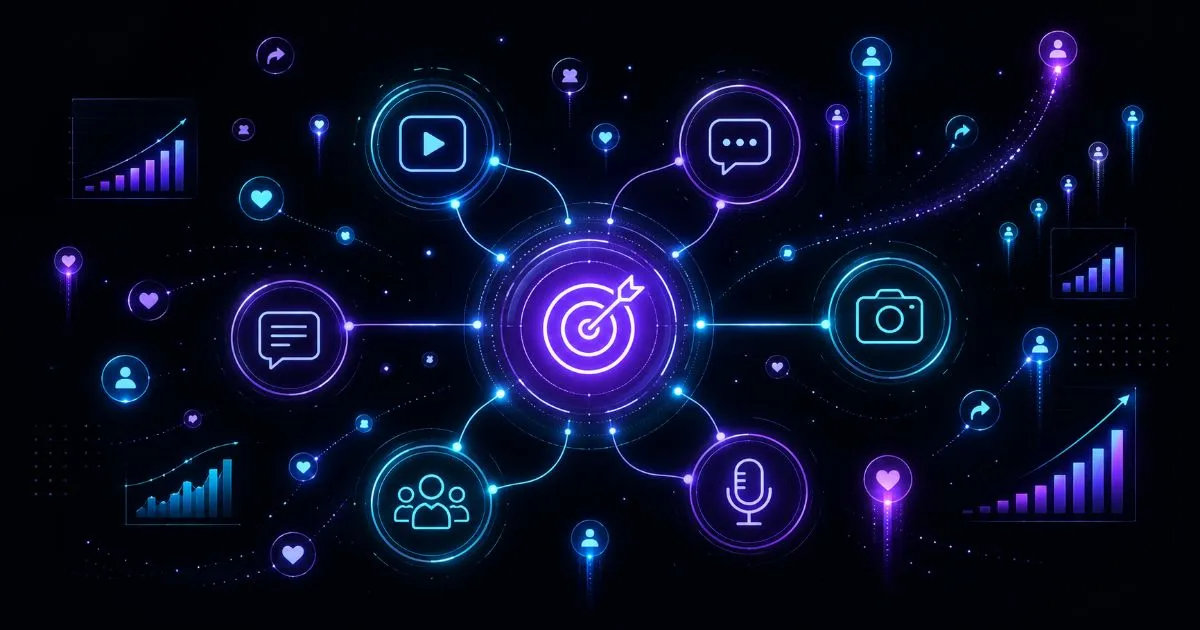
Organic social media marketing — the kind without an advertising budget — has become harder over the years. Platforms limit organic reach to push people towards paid content. Feeds are overcrowded. Users' attention is ever more fragmented. Yet some companies and professionals keep growing organically, building loyal communities and generating real business from social media without spending a cent on advertising.
The difference isn't posting more. It's posting with a clear
Sources: DataReportal, Digital 2025 Global Overview Report
First of all: choosing the right platforms
The first mistake many companies make is trying to be on every platform at once. The result is mediocre content everywhere instead of excellent content somewhere. The choice of platforms must be strategic, based on where your target audience is and which formats suit your type of business.
Ideal for: physical products (fashion, food, furniture, beauty), services with a visual output (photography, design, architecture), lifestyle brands, tourism. Audience: 18–45, mainly female in Italy but with growing male usage. Formats that work: Reels (maximum organic reach), Stories (daily engagement), informative carousels.
Ideal for: B2B services, consulting, professional training, the personal brands of professionals and founders. Audience: decision-makers, professionals, HR. Formats that work: text posts with insights, carousels (PDF documents), long-form articles, native videos.
Ideal for: brands that can deliver quick education about their sector, products with visual demos, services that lend themselves to "before/after" formats. Organic reach on TikTok is still the highest of all platforms for new accounts — the algorithms favour quality content regardless of follower count.
The organic reach of Facebook pages has collapsed below 3%, but the platform remains relevant for local businesses (through groups and Facebook Marketplace), events and niche communities in Groups. For B2C targeting 35–55-year-olds in Italy, Facebook still has an active user base.
Your social editorial plan: structure and frequency
A social editorial plan isn't a calendar where you write down what to post every day. It's a system that defines the thematic pillars, formats, frequency and goals of each type of content — so that publishing becomes a predictable process instead of a daily creative emergency.
Content pillars: the 3–4 topics of your brand
The right frequency for each platform
There's no universal frequency, but these are the guidelines validated by industry data for most businesses:
- Instagram: 4–5 Reels a week for maximum reach + 5–7 Stories a day for engagement + 2–3 feed posts a week
- LinkedIn: 3–5 posts a week for fast growth, 1–2 if you prefer quality over volume
- TikTok: 1–3 videos a day during the initial growth phase, then 5–7 a week once established
- Facebook: 3–5 posts a week for pages, daily updates in the groups you manage
The content batching system
Producing content in batches — spending 3–4 hours once a week creating all the posts for the following week — is far more efficient than creating each post on the day it goes out. Plan, write the copy, prepare the images or record the videos, and schedule everything in advance with tools such as Buffer, Later or Meta Business Suite.
The Instagram algorithm: how it works
Instagram uses different algorithms for the feed, Reels, Explore and Stories — it isn't a single system. Understanding how each works lets you optimise content for every context.
For Reels, the most important signal is the
For the feed and carousels, the main signals are: saves (a sign the content is worth keeping), comments (a sign of conversation) and shares to Stories (a sign of relevance). Likes count for less than these three signals.
For Stories, the algorithm considers how often you watch an account's Stories — accounts whose Stories you view often appear first in the carousel at the top. Stories have no distribution algorithm for non-followers: they only reach people who already follow you, so they serve to keep your existing audience engaged, not to acquire new followers.
TikTok: the platform with the highest organic reach
TikTok is still the platform where a new account with zero followers can reach thousands of people with its first video. This is possible because TikTok's algorithm distributes content mainly based on engagement with the content itself, not on the size of the profile publishing it.
TikTok's distribution funnel works like this: every new video is shown to a small initial batch (200–500 people). If the completion rate and engagement on this batch exceed certain thresholds, the video is shown to a larger batch (5,000–50,000 people). The process repeats — every positive performance leads to wider distribution. A video that "breaks through" can reach millions of people even from an account with 100 followers.
The content that performs best on TikTok for businesses: quick, practical education ("3 things nobody tells you about [topic]"), debunking common myths in your sector, before/after results, authentic behind-the-scenes content, and audio and visual trends adapted to your sector. The tone must be informal and direct — TikTok punishes content that looks like an ad or a corporate presentation.
Content strategy for local businesses: staying relevant in your area
Social strategies for local businesses have important differences from those of national brands. The main goal isn't to build a huge audience but to be recognisable and credible in your geographic area — and to turn that credibility into physical visits, bookings or calls.
For a local business, the social content that works best is: content showing the local area and community (it builds local identity), behind-the-scenes looks at daily work (it creates familiarity before a visit), testimonials from local customers mentioning their neighbourhood or area, taking part in local events with dedicated content, and collaborations with other complementary local businesses for mutual cross-promotion.
On Instagram and Facebook, use geotags — tagging the post's location — to increase visibility in local searches. People looking for content in a specific city or area see geotagged posts. On TikTok, mentioning the city's name in the first 3 seconds of the video and in the audio increases distribution to users in the same geographic area.
Social strategy mistakes that wipe out results
The social metrics that really matter: beyond followers
Follower count is the most overrated social metric. A profile with 50,000 followers who don't interact is worth far less than one with 5,000 highly engaged followers. The metrics that indicate an effective social strategy are different.
Total interactions (likes + comments + saves + shares) / reach × 100. An ER of 3–6% is good on Instagram, 1–3% on Facebook and 2–5% on LinkedIn. Monitor the trend over time — a steady decline signals that your content is losing relevance for your audience.
The number of unique accounts that saw your post. Reach among accounts that don't follow you yet (non-follower reach) is the most important signal for growth: it means the algorithm is distributing your content beyond your existing follower base.
In Google Analytics 4, how many sessions arrive at your site from social media? This is the metric that links your social presence to real business goals. A profile with lots of reach but zero traffic to the site is entertaining without converting.
For service businesses, direct messages received via social media are often the most direct sign of ROI. How many quote requests, questions about services or expressions of interest arrive by DM each month? This metric is hard to track automatically, but it's the one that best measures the business value of your social presence.
Social media and SEO: the often ignored synergy
Social media doesn't directly influence Google rankings (social links are nofollow), but the synergy between social and SEO is real and significant indirectly. Content that gets wide social distribution generates traffic that boosts the behavioural signals (clicks, time on page, low bounce rate) Google views positively. Content that goes viral on social media is often cited and linked by blogs and media — generating organic backlinks. And the brand authority built on social media (people search for your name on Google after seeing you on social) increases branded searches.
The most effective integrated strategy is
LinkedIn for B2B: the platform that generates qualified leads
LinkedIn has the smallest user base of the major social networks but the highest ROI for B2B. 85% of B2B decision-makers use LinkedIn to assess suppliers and partners. A post that generates 50 comments on LinkedIn can be worth more than one that generates 5,000 likes on Instagram, if those 50 comments come from qualified potential clients.
The LinkedIn strategy that works in 2026 is
The formats that perform best on LinkedIn: plain text posts (150 to 700 characters) with specific industry insights, PDF carousel documents with data or practical frameworks (lots of saves, high distribution), native videos uploaded directly to LinkedIn (not YouTube links), and long-form articles published on the platform for anyone wanting to position themselves as an expert on a topic.
The secret of organic LinkedIn growth is consistency within your niche: post about your specific sector every working day for 3 consecutive months and your results in terms of reach, followers and inbound DMs will change significantly. Commitment is the barrier to entry that most people never get past.
Building an active social community: from passive followers to ambassadors
The difference between a social profile with lots of followers and one with an active community is huge in business terms. Passive followers consume content without interacting and don't become customers. An active community comments, shares, asks questions, recommends your products to others and keeps coming back.
The practices that build a real community rather than a passive audience: replying to every comment within 30 minutes of publishing (a strong signal of presence), asking open questions in posts to invite opinions, tagging and quoting people who've shared relevant insights on your content, holding regular live sessions (Instagram Live, LinkedIn Live) where interaction is direct, and treating your most loyal followers as part of the journey — asking for feedback on new products, sharing exclusive previews, creating a private group for the most engaged.
A practical indicator of a healthy community: if you stopped posting for two weeks, would anyone notice and ask you about it? If the answer is yes, you have a community. If the answer is no, you have a passive audience. The goal is the first.
User-generated content: the content customers create for you
How to encourage UGC: create a branded hashtag and encourage customers to use it (e.g. #[yourbrand]results), select and reshare customer mentions in your Stories (it rewards them and encourages others to do the same), run regular challenges or contests that invite people to create content, and publicly thank anyone who creates content about your brand.
The UGC you collect becomes an asset: with the creator's permission (always ask explicitly), you can use it in your paid ads, on your website and in your reviews section. Authentic content created by real users almost always outperforms content created by professional creative agencies, especially in social acquisition campaigns.
A social editorial calendar: practical tools and templates
A social editorial plan stays theoretical until it's turned into an operational calendar. The editorial calendar is the document where "what to post" becomes "exactly what to post, when, on which platform and in which format". Without this level of specificity, planning remains an intention rather than a system.
The elements of each entry in the editorial calendar: publication date and time, platform, content pillar, format (Reel, carousel, text post, Story), specific topic or post title, production status (idea, in production, ready, published) and a link to the content file. A shared Google Sheet with these columns is more than enough for most small teams.
For automatic scheduling, the main tools are: Buffer (simple interface, great for small teams, free plan for up to 3 channels), Later (Instagram-focused, visual drag-and-drop calendar, great for visual content), Hootsuite (enterprise, every channel, built-in analytics, higher cost) and Meta Business Suite (free for Facebook and Instagram, native scheduling with no third-party tools). For LinkedIn, native scheduling is available directly on the platform.
Conclusion: strategy before tools
Before choosing which scheduling app to use, before buying video equipment, before optimising your Instagram bio: define your strategy. Who you are, who you're talking to, what you want to achieve, on which platform, how often and how you'll measure the results. With these elements clear, everything else becomes execution.
If you want to build a social strategy integrated with SEO and content marketing for your business, explore the consulting service or contact me for a strategy session.
Social media presence isn't measured in followers — it's measured in relationships of trust built over time with the right people.
If you want to apply this to your own project, take a look at my digital consulting and fractional CTO service: clear prices from €90/hour, a free quote and a reply within 24 hours.